Last Updated: September 8, 2026
For a business, it is expected to have a plan to maintain and enhance competitiveness by being able to efficiently utilized resources, adapt to any changes, be able to introduce new ideas or penetrate into new market, increase employee efficiency, and build for future growth. All this is possible because of strategic planning.
The purpose of strategic planning is to be able to identify where the business is at the moment, and where it wants to be. Thus, the organization should consider what needs to be done in order to get from one place to another, what resources, people, and time it will take.
This article is belongs to Business Growth
Usually, in strategic planning, there are several steps performed, including defining business goals, analyzing both internal and external elements, considering strengths and weaknesses, competitors, opportunities, and setting up objectives.
There are a number of tasks that need to be accomplished in order to succeed in business. Strategic planning is not an exception here, and in order to be able to do everything that needs to be done in order to run a business successfully, you need a plan.
This guide will tell you more about the concept of strategic planning, the need for having such a plan, the process of creating one, and the role played by various aspects of business management in this process.
Table of Contents
What Is Strategic Planning?
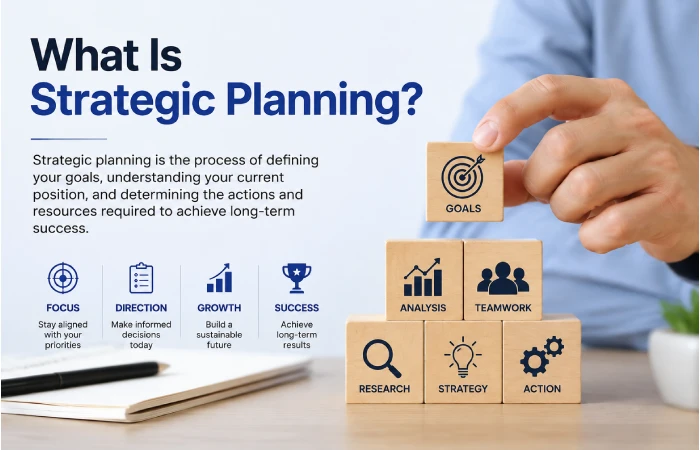
Strategic planning is an organizational process where the organization’s leaders define the vision for the future whilst identifying the organization’s goals and objectives. The procedure involves the sequence in which the goals must be realized so that the organization can acquire the intended vision. Strategic planning represents long-term goals and is distinct from business planning, which focuses on tactical goals. The product is a strategic plan which can be easily shared, understood, and followed by various people, including business partners, customers, investors, and employees. Organizations need to conduct strategic planning to consider the impact of changing business. A strategic plan needs to be revised to reflect the changes needed to be brought about in an organization. Enrolling in a business strategy online course can be quite instrumental for business leaders in many cases.
A strategic plan typically includes:
- A business vision
- A mission statement
- Long-term objectives
- Short-term goals
- Market and competitor analysis
- SWOT analysis
- Marketing strategy
- Operational priorities
- Financial objectives
- Employee and organizational goals
- Key performance indicators
- Risk management measures
- Review and improvement processes
Strategic planning is the approach and planning of all activities for an entire organization whereas day to day business planning would approach activities at a much lower organizational level (operations business planning for instance).
For instance, your business plan might discuss how you’ll achieve sales over the coming year, whereas a strategy might define the destination your company wishes to reach five years from now – and the skills you need.
Those in a profession and wishing to enhance their skills in making strategy based decisions could also benefit from a [business strategy online course] in to gain further knowledge about strategy management, leadership and organizational planning.
Why Is Strategic Planning Important?
The external environment in which companies operate is one of change. Customer needs change, competitors launch products into the market, technology revolutionizes the ways companies operate and economic circumstances may be factors in affecting sales and costs.
By using strategic planning, businesses can address these future shifts instead of reacting to them only as they occur.
By having a robust strategic plan an organization can:
- Establish a clear direction
- Identify growth opportunities
- Allocate resources more effectively
- Improve decision-making
- Understand competitors
- Align employees around common objectives
- Improve marketing performance
- Control unnecessary costs
- Monitor business performance
- Prepare for potential risks
- Build sustainable competitive advantages
Strategic planning is therefore not simply an annual exercise. It should become an ongoing management process.
The Key Elements of a Strategic Plan
All organization’s plans differ, however the most successful strategic plans include all of the elements below.
- Vision
A vision states what the business wants to achieve in the future. Such a statement must have a set of goals which are challenging but not unrealistic, and should help employees, clients, shareholders and other groups to understand where the company is moving into the future.
For instance, A technology company’s vision could, for example, be as ‘The No.1 supplier of low-cost digital resources to small and medium businesses.
Your vision is about where you’re headed. Your strategy is about how you’ll get there.
- Mission
Their mission statement sets out their reason for existence and what they plan to do with that service for their customers.
Where vision concerns future plans, the mission describes the present objective of the organization.
Knowing its mission enables companies to make decisions in agreement with the reason for the existence of the organization.
- Business Goals
Goals translate the vision into practical outcomes.
Businesses may establish goals related to:
- Revenue
- Market share
- Customer acquisition
- Customer retention
- Product development
- Geographic expansion
- Employee development
- Operational efficiency
- Brand awareness
Goals should be specific enough to measure and evaluate.
- SWOT Analysis
SWOT analysis is one of the most widely used strategic planning techniques.
SWOT stands for:
- Strengths
- Weaknesses
- Opportunities
- Threats
A “strength” or “weakness” is something within, and “opportunity” and “threat” are things outside.
By example, a strong brand identity might be a strength to a business and a weak cash position could represent a weakness. A developing market place could provide an opportunity whilst aggressive competitors could constitute a threat.
The purpose of SWOT analysis is not simply to create a list. Use this data to develop strategic priorities for the business.
How to Develop a Strategic Plan
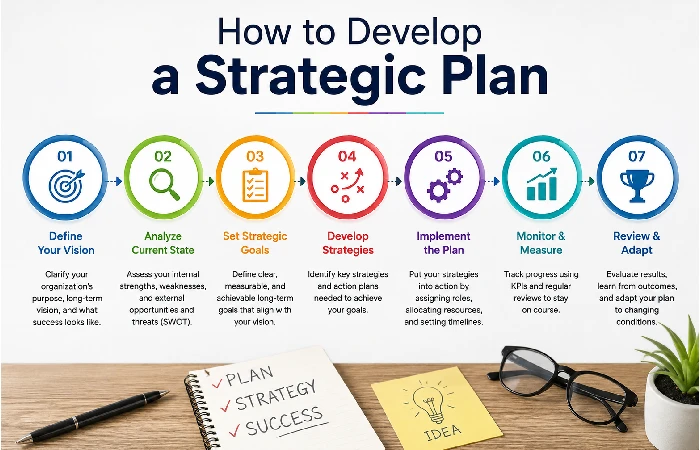
Making a strategic plan is not hard work to be put on, it is at the minimum not easy at all.
Step 1: Understand the Current Business Position
It is not possible for leaders to know where to lead the business if first you do not know where to start the business.
This involves analyzing:
- Revenue
- Profitability
- Customer base
- Products and services
- Market position
- Employees
- Operational performance
- Marketing channels
- Competitors
- Available resources
Businesses should use real numbers over guesses to guide all business decisions, a wise and productive habit to adopt.
Step 2: Analyze the Market
This research may also identify opportunities, customers, trends and possible competitors.
If a company is looking at expanding in a different region, for instance, they want to know who are the customers, what’s competition, what laws govern the territory, what do prices look like, where to distribution etc..
The marketing element should be seen as a part of the bigger picture. The company can refer to practical ways of [marketing a business idea] whilst formulating a go-to-market plan.
Step 3: Identify Your Target Customers
Clearly define target markets the strategic plan should outline the organization’s chosen target markets.
Marketing to the correct audience will enable an organization to create products, marketing strategies, price structures, and experiences that are more aligned with what those customers want.
What are the relevant issues?
- Who are the ideal customers?
- What problems do they experience?
- What motivates their purchasing decisions?
- Where do they search for information?
- What competitors do they currently use?
- How much are they willing to pay?
- What factors influence customer loyalty?
A company that attempts to serve everyone may struggle to create a clear market position.
Step 4: Study Competitors
Through competitor analysis, organizations can understand which other businesses their customers are using and how those competitors are generating revenue.
Businesses should evaluate competitors based on:
- Products and services
- Pricing
- Customer experience
- Brand positioning
- Marketing channels
- Online presence
- Strengths
- Weaknesses
- Customer reviews
The aim isn’t about simply ‘copying the competition’, but about understanding where the openings in the marketplace are.
Step 5: Define Strategic Objectives
Once you understand how and where your organization is now positioned within the current market and its environment you now need to determine exactly where it is you want to go – in other words you have now set your strategic objectives.
A good objective must be quantifiable and aligned with overall business objectives.
For example:
“Boost the volume of qualified leads via our website by 30% in the next year.”
This is more useful than simply stating:
“Improve marketing.”
Sets a target for comparison. Allows responsibility to be assigned and measured.
Strategic Planning and Business Growth
One of the most common motives driving an organization to produce a strategic plan is growth.
There are a few main ways an organization can grow, including bringing in new customers, getting customers to spend more, going into new markets, introducing new products, retaining existing customers more effectively, or coming up with new income streams.
However, growth without planning can create serious problems.
Rapid expansion may increase:
- Operating costs
- Employee requirements
- Customer service demands
- Inventory requirements
- Technology needs
- Cash-flow pressure
Based on that businesses now need to work out if they have the capacity and the infrastructure for success and expansion.
Having a clear [business growth plan] allows organizations to develop appropriate growth opportunities and avoid unnecessary risk.
Organizations can also evaluate practical techniques to accelerate business growth when turning strategic objectives into measurable and sustainable growth initiatives.
Marketing as Part of Strategic Planning
Marketing should not operate separately from the overall business strategy.
Marketing’s goals must be aligned with overall business objectives.
If, for example, the strategic objective of the business organization is the entry into new markets, then the marketing strategy will primarily emphasize customer awareness and insight, building relationships with key local players, advertising using digital channels, and leveraging of content marketing. It will have an emphasis on search optimization (SEO).
Businesses should evaluate multiple marketing channels, including:
- Search engine optimization
- Content marketing
- Social media
- Email marketing
- Paid advertising
- Partnerships
- Public relations
- Referral marketing
- Events
- Direct sales
The appropriate mix depends on the target audience and business model.
Businesses can also explore [effective techniques for elevating and marketing a business] when developing a broader marketing strategy.
A growth-oriented marketing strategy can further connect marketing activities with broader business objectives, helping organizations make more deliberate decisions about customer acquisition, retention, and sustainable revenue growth.
Developing a Strong Business Idea
A company can develop even before its launch.
Entrepreneurs must first consider whether their planned solution can actually solve a real problem that most customers have, and whether there is any demand that they can exploit for.
A business idea should be evaluated based on:
- Customer demand
- Market size
- Competition
- Startup costs
- Revenue potential
- Scalability
- Resources
- Skills required
- Potential risks
A promising idea still requires a realistic implementation strategy.
Entrepreneurs can also examine different [business ideas for rural areas] when assessing opportunities outside major urban markets.
Choosing the Right Revenue Model
Your plan of action should address exactly how the organization will generate money.
Different businesses use different revenue models, including:
- Product sales
- Subscription fees
- Advertising
- Licensing
- Commission
- Freemium models
- Consulting fees
- Memberships
- Transaction fees
The correct revenue model is dependent on the product, the behavior of the customer, the market and the operational system.
To illustrate some, subscription or advertising models might be applicable for the digital businesses whereas the project-based or contract-based service businesses would possibly take subscription or contract for their system.
Understanding how a [revenue model works for online games] can also provide an example of how digital businesses structure multiple income sources around user activity and engagement.
Building an Effective Company Culture
People are central to strategic execution.
A company may develop a phenomenal strategy; nonetheless the strategy will falter if employees don’t quite understand their roles or feel disenfranchised by organizational goals.
A healthy company culture encourages:
- Communication
- Collaboration
- Accountability
- Respect
- Learning
- Innovation
- Employee recognition
Companies need to routinely question whether or not their work environment can support their strategy.
Knowing the [indicators of a healthy work culture] will make it easy to recognize whether specific areas within the workplace contribute to the employee and contribute to the retention of employee
Employee Engagement and Strategic Execution
“Our employees also need a sense of how the work they do relates to what’s going on at the organizational level.”
Leadership teams should communicate:
- What the company wants to achieve
- Why the objective matters
- What employees are expected to do
- How performance will be measured
- How success will be recognized
Employee engagement can be enhanced when employees are given interesting work and when employees know their work makes a difference to how well the business performs.
Organizations should consider initiatives relating to [positive ways to increase staff engagement] in their wider people plan.
Individuals can also support overall success by forming good habits for [an inclusive workforce.
Time Management and Strategic Planning
Many strategic objectives go unrealized because teams get consumed by the day to day demands of the organization.
Time management should be used to keep staff and organization focused on the tasks and activities that directly relate to achieving the critical organizational objectives.
Effective approaches include:
- Prioritizing high-value tasks
- Establishing deadlines
- Reducing unnecessary meetings
- Delegating responsibilities
- Using project management tools
- Reviewing workloads
- Setting realistic schedules
Understanding the [definition of time management] can help employees and managers recognize the relationship between effective time use and business performance.
Strategic planning therefore needs to be connected to daily execution.
A strategy that exists only in a document is unlikely to produce meaningful results.
Managing Business Costs
Financial assets should be deployed based on strategy.
Business will have to identify what expenses enhance growth and what expenses are costing the business for the same or perhaps even a lesser performance.
Cost management can involve:
- Reviewing supplier agreements
- Improving operational efficiency
- Automating repetitive processes
- Reducing unnecessary administrative work
- Outsourcing specialized tasks
- Improving resource utilization
- Negotiating better contracts
For example, companies that do a lot of writing – meeting minutes, interviews, customer calls – might investigate if it makes sense to bring in an external transcription service to boost output or relieve internal pressure.
This makes [ways businesses can save costs by opting for transcription services] relevant to broader operational planning.
Cost reduction should not simply mean spending less. The objective should be to obtain greater value from available resources.
Efficient financial management can also support strategic execution by helping businesses maintain accurate records, monitor expenses, and make informed decisions. Businesses that rely on QuickBooks may benefit from QuickBooks support for small businesses when managing their accounting processes alongside broader operational goals.
Strategic Planning for Business Operations
Operations refers to a businesses ability to delivery products or services effectively.
A strategic plan should consider:
- Supply chains
- Production
- Technology
- Customer service
- Logistics
- Internal processes
- Quality control
- Staffing
- Office requirements
Business operations typically evolve with business expansion.
For instance, if your company moves into a new office space you will need to evaluate productivity and the demands placed upon all company equipment, transport and communications as well as minimize lost operating time.
As a result [corporate move management] is likely to be just one element of your wider operational plan when developing the firm, when expanding or when reorganizing.
Using Technology to Support Strategy
Technology can also lead to more enhanced product, efficiency, customer service, data visualization and decision-making skills for an business.
Businesses need to decide where their technology aligns with its overall strategic and organizational goals.
Useful technology investments may include:
- Customer relationship management systems
- Analytics platforms
- Project management software
- Accounting systems
- Marketing automation
- Communication platforms
- Cybersecurity tools
- Cloud services
- Artificial intelligence
Despite that, companies should not purchase technologies simply because they are popular.
Every technology investment should answer a practical question:
What business problem will this solve?
Expanding Into New Markets
Market penetration can offer huge potential for growth but is also more perilous.
Before entering a new market, businesses should evaluate:
- Customer demand
- Competition
- Local regulations
- Pricing
- Distribution
- Cultural factors
- Marketing channels
- Staffing
- Logistics
As an example; a firm wanting to advertise in particular geographic area should know what will appeal to the target customers and who are all the competitors to avoid costly misjudges.
A strategic approach to [advertising a business in Texas] or another regional market should therefore begin with market research rather than simply increasing advertising expenditure.
Measuring Strategic Performance
A strategy needs measurable indicators.
Key performance indicators, KPI in business, can give you an indication of whether or not you are heading in the right direction with your business goals.
Depending on the business, KPIs may include:
- Revenue growth
- Profit margin
- Customer acquisition cost
- Customer lifetime value
- Conversion rate
- Website traffic
- Lead generation
- Customer retention
- Employee turnover
- Productivity
- Market share
Each KPI should be connected to a meaningful business objective.
Tracking hundreds of metrics that has little bearing on the situation will inevitably get confusing and businesses need to select the metrics that actually represent strategy execution progress.
Reviewing and Updating the Strategic Plan
A strategic plan should never be considered permanent.
Market conditions change. Competitors change. Customer behavior changes. Technology changes. Internal capabilities change.
Businesses should therefore review their strategy periodically.
During a strategic review, leaders can ask:
- Are we achieving our objectives?
- Which strategies are working?
- Which strategies are underperforming?
- Have customer expectations changed?
- Has the competitive environment changed?
- Are our financial assumptions still realistic?
- Do we need new employees or skills?
- Are there new opportunities?
- Have new risks emerged?
The strategic plan should then be updated accordingly.
Managing Business Risk
Every business face uncertainty.
Strategic planning allows organizations to detect problems before they develop into issues.
Such issues could be:
- Economic downturns
- New competitors
- Supply-chain disruptions
- Cybersecurity incidents
- Regulatory changes
- Employee shortages
- Changing customer preferences
- Technology disruption
- Cash-flow problems
Business must assess major risks, so that they have plan to deal with.
“Risk Management Is Not the elimination of uncertainty. It is an effort to make sure that organization is adequately prepared to cope when that uncertainty takes effect.”
Strategic Planning and Business Exit
Strategic planning is for beyond the startup and expansion phases of business; business owners can also strategize for the inevitable sell of their business.
Business proprietors may finally want to:
- Sell the company
- Transfer ownership
- Merge with another organization
- Bring in new investors
- Retire
- Pass the business to family members
An exit strategy should ideally be considered well before the owner intends to leave.
Exploring [business exit strategies for entrepreneurs] helps the owners predict the long-term effect of today’s business decisions on the enterprise’s future value and transferability.
Strategic Planning for Entrepreneurs
Resources for entrepreneurs are typically scarce which makes prioritization a fundamental necessity.
Entrepreneurs must avoid chasing every opportunity, but rather identify and pursue the specific actions that can yield meaningful returns.
An entrepreneur’s strategic plan may focus on:
- Identifying a clear customer problem
- Validating the business idea
- Defining the target market
- Establishing a competitive advantage
- Creating a revenue model
- Developing a marketing strategy
- Managing costs
- Building the right team
- Establishing measurable goals
- Preparing for future growth
Entrepreneurs should be open minded as well. A business plan gives us directions, but we are not restricted by the plans if we have new information.
Working From Home and Strategic Flexibility
Working remotely and using flexible schedules becomes more common for new businesses.
Work-from-home opportunities may save small business owners and entrepreneurs money in areas, like administrative staff costs, and flexibility.
Potential opportunities include:
- Freelancing
- Consulting
- Online education
- E-commerce
- Digital marketing
- Content creation
- Virtual assistance
- Software services
Entrepreneurs interested in [potential money earning jobs from home] may want to take a look at each opportunity in respect to what the market dictates for those specific areas, the skills needed to compete, and startup costs.
A long term view must be kept in mind here, and just like anything else strategic – analyze before you invest anything of significance.
Communication Is Critical to Strategic Planning
Even the greatest strategy can fail to be implemented if communicated poorly.
Employees need to know what the business is attempting to do and how their own role helps to achieve these goals.
Good strategic communication should be:
- Clear
- Consistent
- Specific
- Two-way
- Relevant
- Regular
Leaders should have the attitude to enable employees to ask questions or make suggestions.
Good communication can reduce confusion and allow departments to align better.
Companies that aspire to better execution, and have already focused on[work management and communication], need to do a little more homework.
Bringing the Team Together
Building a sense of unity through strategic planning. If people know the goals of their organization teams tend to work much better together.
The marketing may target customer acquisition, sales targets may be based on conversion and customer service may target retention; and operations may target a great customer experience.
These operations may run independently of each other but are aiming towards the same goals.
Clear roles and shared KPIs help this goal.
Common Strategic Planning Mistakes
Strategic planning may falter if organizations fall to avoidable errors.
Setting vague objectives
Such objectives are tough to define: “Improve Sales”. Or “Enhance marketing”.
Goals should be specific and have definite time limits to achieve.
Ignoring competitors
A strategy which hasn’t taken potential competition into account, could be totally out of place
Customers must identify all their business competitors and the way they try to achieve same target Customers
Focusing only on short-term results
While this short-term performance is critical, they must also make the investment for long-term capabilities.
Creating unrealistic plans
During strategizing you should account for such factors as cash, employees, technology and time.
Failing to communicate
Employees cannot execute a strategy they do not understand.
Not measuring performance
KPI’s provide a clear indication of if your business strategy is paying off.
Refusing to adapt
While a strategy plan does indicate the way to go, leaders have to adapt to changing conditions.
A Practical Strategic Planning Framework
For businesses, the strategic planning process may be simplified by the following framework:
- Assess:
Analyze your position within the organization. - Analyze:
Investigate customers, competitors, markets, inner capabilities, strengths, weaknesses, opportunities and threats. - Define:
Develop company vision, mission, strategy goals. - Priorities:
Identify the activities with the most leverage. - Execute:
Tasks and ownership, resources and budget, timescales. - Measure:
Monitor performance and KPIs. - Review:
Determine what works and what should not. - Adapt:
Revise the strategy based on new information and conditions.
Therefore, instead of a onetime strategic planning operation, you are left with a cycle on ongoing strategic management.
Conclusion
Strategic planning creates a framework for organizations to decide where they’re going to go, and what they want to achieve on their journey to get there. It links the business’s vision to their aims, assets, human capital, actions, decisions in key areas of the organization and metrics.
An effectively framed plan starts from a state diagnosis in the organization and then leaders develop the strategic plans from a perspective of the market, objectives and target, threats and opportunities, strategic options, actions to be taken and goals with indicators.
Strategic planning covers beyond development of organization, in addition to marketing, human resources, business culture, operations, time planning, finance control, investment in new technology and market, risk prevention or future sale of the business.
Business leaders should take strategic planning not as a passive document created but something to rely upon for making decisions during everyday activities.
By combining its overall long-term objectives, measurable goals and changeable methods, a business is better prepared to cope with changing events and steady growth of its organizations.
No matter if we are establishing a new business, broadening one, having to do something about marketing of the business or about human resources and organizations, launching into the market, or selling a business, we would always use strategic planning to achieve the desirable future state for the company.