
Last Updated: September 4, 2026
You’ve built a business that any reasonable entrepreneur ought to be proud of. It doesn’t matter if you are ready to retreat and rest. You may want to enjoy the rewards or simply push yourself ahead and move on to the next chapter of life.
Before you can retire and live off the dividends from the sale of the business you founded, you’ll want to decide how to walk away gracefully. Another option is to scale back your management role while still benefiting financially from the enterprise.
Planning an exit takes time and careful thought. A transition involves more than dollars and cents. It also affects employees, customers, vendors, business partners, and the people who’ll one day take your place.
These five exit strategies can all help you achieve that goal. Some represent a total break with the business. Others move you into more of a “silent partner” role. Evaluate them and decide which makes sense for you.
This article is belongs to Entrepreneurship & Startups
Table of Contents
Take on a Strategic Partner and Step Back
If you want to retain a financial interest in your business, consider selling part of it to a strategic partner. You may also retain a say in the direction of the company. This preserves the upside of ownership while creating new opportunities for growth.
“One way to offer new services without sacrificing productivity is to form a strategic partnership with another business,” according to business advisory group DeLeon & Stang.
Depending on the business’s lifecycle and industry, the strategic partner could be another competitor in the same industry. It could also be a companion business that operates in a parallel industry. The strategic partner might also be a capital partner, such as a private equity firm. Speak with your business coach or a sell-side advisor to determine your particular situation.
A strategic partnership can allow for a phased withdrawal rather than an immediate departure. This reduces your role in day-to-day operations as the partner’s involvement grows. Before approving any deal terms, determine expectations regarding roles, decision-making, ownership, and how each partner will exit its investment.
Prepare for an Initial Public Offering
Preparing for an initial public offering is more work than taking on a strategic partner. However, it could lead to a bigger payoff and perhaps a cleaner break with the business. Remember, you don’t have to include every common share in the IPO. You can keep as much as you’d like for the current ownership group.
An IPO is always going to be a significant process, so you’ll want to prepare far in advance of an actual IPO offering. The company’s required reporting and governance standards may change to higher levels of transparency and scrutiny. Ask yourself whether your company is prepared for that. Don’t view an IPO merely as another avenue through which to divest.
Sell Your Stake to a Partner or Major Shareholder
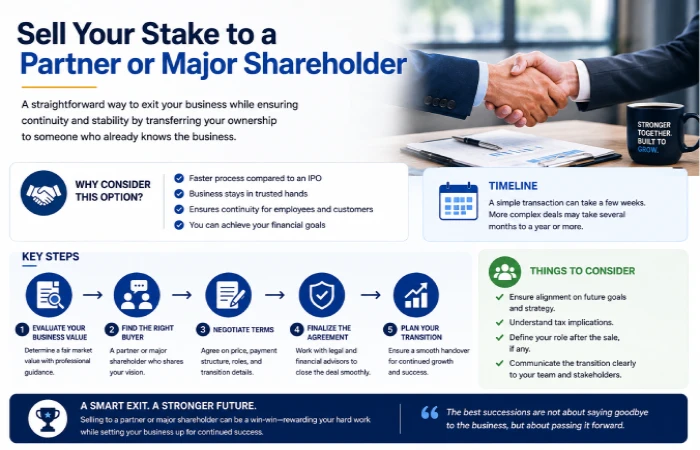
Another option is to sell your personal stake in the business to a fellow partner or major shareholder. This could be faster than an IPO. A straightforward transaction may take a few weeks, while a complicated one can take a year or more, according to Acquire.
This approach relies on a mutually acceptable price for the business or equity portion being acquired. It also requires agreement on the other transaction specifics. This helps reduce ambiguities regarding payment arrangements, responsibility, and the exact date upon which ownership is transferred. There are also many professionals who can provide financial and/or legal advice. They can help you determine whether this is the appropriate move to make.
Sell to Your Employees
Also known as an ESOP, an employee stock ownership plan allows you to reward your employees for a job well done by giving them literal ownership in the business. Despite that, it can take many years to completely transfer ownership. Therefore, it’s probably not wise if you want a swift departure.
This type of employee-focused sale can have more heart if you’ve nurtured a solid business team. You may want the company to go to people who are already familiar with its culture and customer base. This can also allow for a smoother transition during what may be disruptive times. Consider whether the framework works for your desired timeline and bottom line.
Merge With a Competitor or “Complementor”
Last but certainly not least, consider merging your business with another. This option is similar to taking on a strategic partner. However, you’re combining two distinct businesses into one. Depending on the deal structure, you could retain an ownership stake in the new business. You may also have a more active role. However, you’re probably not looking for too much extra responsibility if your ultimate objective is a clean exit.
There can also be practical considerations of a merger that you need to weigh. The management philosophies, procedures, culture, and expectations may not be aligned between the two companies. How that gap will be reconciled is every bit as important as setting the financial parameters. If a merger happens, it will need a road map for what lies beyond the close.
Exploring Your Next Business Opportunity
Choosing the right path after building a successful company requires careful planning. Whether evaluating different exit strategies for entrepreneurs or planning your next move, building business credit can help strengthen your financial foundation. Entrepreneurs can also benefit from exploring expert perspectives on entrepreneurial exit strategy when planning a successful transition.
For entrepreneurs who are ready to begin something new, exploring how to start a print-on-demand business can be an interesting option. A flexible online business model may provide an opportunity to create a new source of income while applying the knowledge and experience gained from previous entrepreneurial ventures.
Onto the Next Adventure
Leaving your current business behind doesn’t mean you have to hang up your entrepreneur’s hat for good. In fact, it could be an opportunity to begin the next stage of your business career. You can do so unencumbered by your previous endeavors and with more capital to invest in your next adventure.
The right exit strategy will depend on what you want your life and finances to look like after the transition. Some owners may prioritize a complete separation. Others may prefer to remain involved in a limited capacity. Your preferred timeline, the company’s financial position, the strength of its management team, and the interests of other owners can all influence which option makes the most sense.
It’s also worthwhile considering life beyond the actual sale. What are the implications for customers, employees, contracts, intellectual property, and any other vital component of the business following the end of your reign?
With careful consideration, a smooth succession plan will preserve all the hard work and value you have accumulated over the years. It can also ease the way for a new owner or management team.
Of course, it’s important to exit your business the “correct” way. The process should benefit you, any remaining partners, any remaining employees, and possibly others with a stake in the enterprise. There’s nothing better than starting with a totally blank slate.