
Last Updated: September 4, 2026
Table of Contents
Start A Print on Demand Business
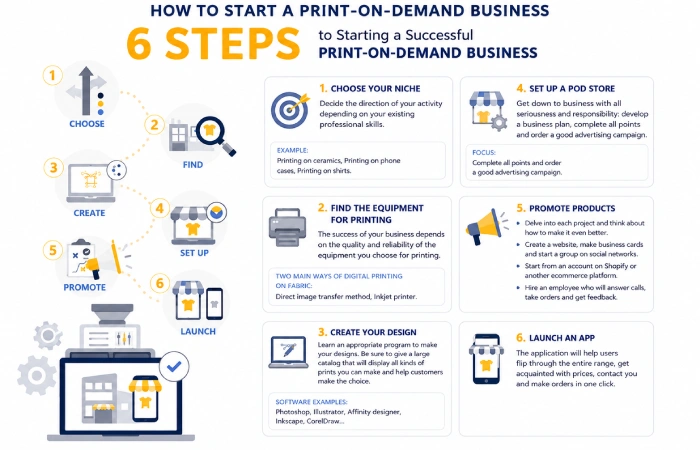
Below infographic guide you on how to start a print on demand business.
6 Steps to starting a successful print-on-demand business.
- Choose Your Niche
- Find the equipment for printing
- Create your design
- Set up a Pod Store
- Promote Products
- Launch an App
This article is belongs to Entrepreneurship & Startups
Starting a print-on-demand business can be an attractive option for entrepreneurs who want to sell customized products without maintaining a large inventory. The basic idea is simple: products are created or printed when customers place orders. This can reduce the need to purchase and store large quantities of products before knowing whether they will sell.
However, a successful print-on-demand business requires more than simply creating designs and uploading them to an online store. You need to select a suitable market, choose reliable printing equipment or suppliers, create appealing designs, establish an effective online store, promote your products, and make it easy for customers to place orders.
The infographic above highlights six important steps to starting a successful print-on-demand business. Each step plays an important role in building the business and creating a smooth customer journey.
1. Choose Your Niche
The first step is to choose a niche for your print-on-demand business. A niche helps you identify the type of customers you want to serve and the products or designs that may appeal to them.
For example, you could focus on printing designs on shirts, ceramics, phone cases, mugs, bags, or other customizable products. Instead of attempting to serve everyone, choosing a specific audience can make it easier to develop relevant products and promotional messages.
Think about your existing skills, interests, and knowledge when selecting a niche. You should also consider customer demand and competition. A good niche gives you enough potential customers while still allowing your business to develop a recognizable identity.
2. Find the Equipment for Printing
The second step is finding reliable equipment for printing. The success of your business can depend heavily on the quality and reliability of the equipment you use.
The infographic highlights two main approaches to digital printing on fabric: the direct image transfer method and inkjet printing. Your choice will depend on the products you intend to create, your budget, production requirements, and the level of quality you want to achieve.
Equipment is also an important financial consideration for a new entrepreneur. Before making major purchases, calculate your expected costs and consider how much capital you need for equipment, materials, packaging, software, website development, and marketing.
Businesses that need additional capital should also understand how financial planning affects growth. Establishing strong financial foundations and following practical tips for startups to build business credit can help entrepreneurs prepare for future business expenses and financing needs.
3. Create Your Design
Once you have selected your niche and determined your printing requirements, the next step is to create your designs.
The infographic recommends learning an appropriate design program and building a large catalog of designs. Examples of design software include Photoshop, Illustrator, Affinity Designer, Inkscape, and CorelDraw.
Your designs should match the interests of your target customers. A visually appealing design can encourage customers to explore your products, share them with others, and make purchases.
It is also useful to create different design variations. You can experiment with typography, illustrations, colors, layouts, and themes while maintaining a consistent style across your product range.
Before publishing a design, make sure it is suitable for the product on which it will appear. A design that looks good on a computer screen may require adjustments before it is printed on clothing, ceramics, phone cases, or other products.
4. Set Up a POD Store
The fourth step is setting up your print-on-demand store. According to the infographic, this stage should be approached with seriousness and responsibility.
Develop a business plan and determine which products you want to sell. You should also make sure that your store provides customers with enough information about your products, pricing, ordering process, and delivery options.
A professional store should be easy to navigate. Product images should clearly show what customers are purchasing, while product descriptions should provide useful information. When planning how to attract customers and sell products, entrepreneurs can also refer to the SBA’s marketing and sales guidance for practical advice on target markets, sales plans, marketing goals, and promotional activities.
You should also consider how customers will move through the buying process. A simple checkout process can reduce unnecessary barriers and make it easier for visitors to complete their orders.
Your store can also become an important part of your overall brand. Consistent product presentation, design, messaging, and customer communication can help customers recognize and remember your business.
5. Promote Products
Creating products is only one part of building a successful print-on-demand business. Customers also need to discover your products.
The infographic recommends thinking about how each project can be improved and using business cards and social networks to promote the business. You can also create accounts on Shopify or another ecommerce platform and establish a presence where your target customers spend time online.
Social media can be particularly useful for showcasing new designs. You can publish product photographs, demonstrations, customer-created content, promotions, and behind-the-scenes material.
Your promotional activities should also encourage customer interaction. Responding to questions and collecting feedback can help you understand which designs and products attract the most attention.
If your business grows, you may also need an employee or team member who can answer calls, take orders, and collect customer feedback. Good customer communication can help you identify problems and improve the overall buying experience.
6. Launch an App
The final step shown in the infographic is launching an app.
An application can make it easier for customers to browse products, contact your business, and place orders. The infographic highlights the ability of an app to help users move through the entire range of products and make orders conveniently.
However, an app should support your business rather than simply exist for the sake of having one. Before investing in app development, consider whether your customers are likely to use it and whether it provides meaningful advantages over your website.
An app could be particularly useful once your customer base becomes established. Features such as product browsing, order tracking, notifications, customer support, and promotions can help create a more convenient shopping experience.
Plan for Long-Term Growth
A print-on-demand business should not be viewed only as a short-term opportunity. Entrepreneurs should consider how the business could develop as customer demand increases.
You may eventually expand into new product categories, introduce additional designs, work with new suppliers, develop a stronger brand identity, or enter new markets.
It is also sensible to think about what you want to achieve in the long term. Entrepreneurs should understand their options if they eventually decide to sell, transfer, or restructure the business. Planning ahead with appropriate exit strategies for entrepreneurs can help business owners make more informed long-term decisions.
Keep Improving Your Print-on-Demand Business
The six steps in the infographic provide a useful starting point, but building a successful print-on-demand business requires continuous improvement.
Monitor which products receive the most attention and which designs generate the most sales. Pay attention to customer feedback and identify areas where your website, products, pricing, ordering process, and promotional campaigns can improve.
You should also keep testing new designs and marketing approaches. A design that performs well today may not remain popular forever, so regularly refreshing your product catalog can help keep your store interesting.
Most importantly, focus on providing customers with products they actually want. When niche selection, design quality, reliable production, store usability, promotion, and customer service work together, a print-on-demand business has a stronger foundation for sustainable growth.